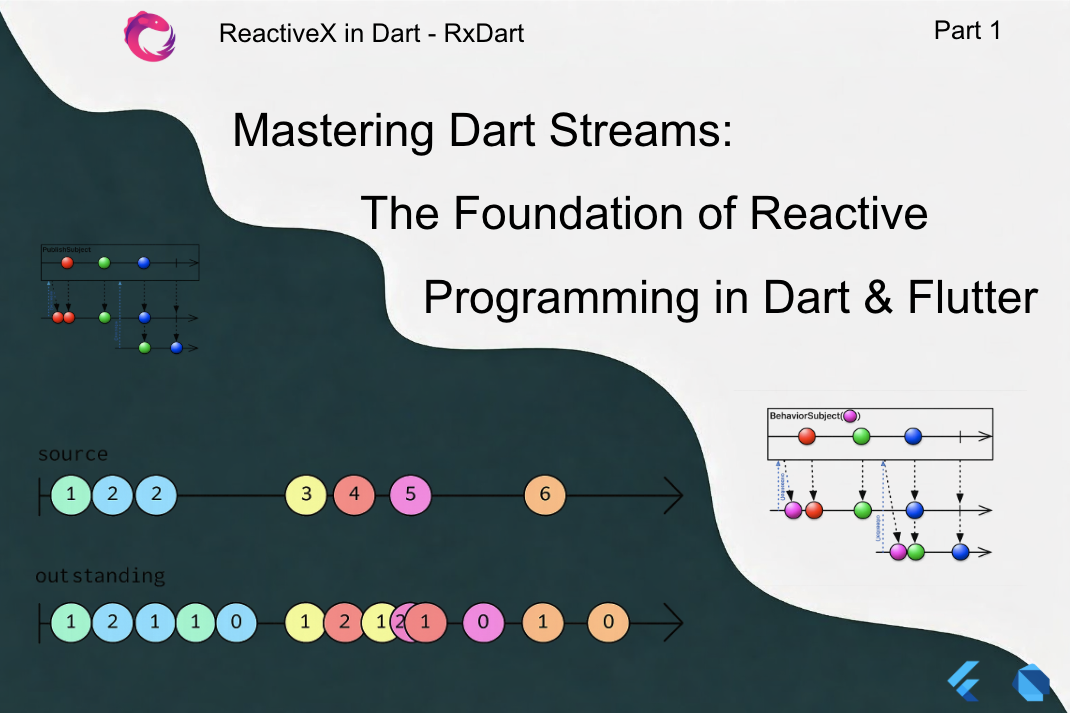
Reactive programming is one of the most powerful paradigms for building scalable asynchronous applications. In Flutter development, many engineers encounter reactive patterns through state management libraries, but few fully understand the underlying mechanics.
Before using RxDart effectively, it is critical to master Dart Streams. RxDart does not replace the Dart asynchronous model; instead, it extends and enhances it.
This article will explore:
- the internal mechanics of Dart Streams
- how asynchronous event pipelines work
- limitations of native Streams
- why RxDart exists
- practical production examples
By the end of this article, you will understand the core reactive model powering Flutter applications.
1. The Asynchronous Problem in Modern Applications
Modern mobile applications rarely perform linear synchronous operations. Instead, they deal with multiple asynchronous data flows simultaneously.
Typical sources of asynchronous events include:
| Source | Example |
|---|---|
| User interactions | typing in a search box |
| Network responses | API calls |
| Database updates | SQLite / cache |
| WebSocket streams | live chat |
| Device sensors | GPS updates |
| System events | connectivity changes |
Consider a simple Flutter feature:
User types search query
↓
Send API request
↓
Receive result
↓
Update UI
A naive implementation might look like this:
Future<void> search(String query) async {
  final results = await api.search(query);
  setState(() {
    items = results;
  });
}
However, this quickly becomes problematic.
Problems
- Multiple API calls
Typing:
A
Ap
App
Appl
Apple
Triggers 5 API requests.
- Race conditions
The response order may differ:
Request: Appl
Request: Apple
But the network returns:
Apple response
Appl response
Now the UI shows incorrect results.
- Cancellation complexity
You must manually cancel requests.
- State coupling
UI logic becomes tightly coupled with business logic.
Reactive programming solves these issues by modeling application data as streams of events.
2. What is a Stream?
A Stream represents a sequence of asynchronous events over time.
Conceptually:
time →
event1 → event2 → event3 → event4
Unlike a Future, which produces one value, a Stream produces many values.
Future vs Stream
| Feature | Future | Stream |
|---|---|---|
| Values | One | Multiple |
| Duration | Once | Continuous |
| Use case | API call | user input / socket |
Example:
Stream<int> numbers() async* {
  yield 1;
  await Future.delayed(Duration(seconds: 1));
  yield 2;
  yield 3;
}
Listening to the stream:
numbers().listen((value) {
  print(value);
});
Output:
1
2
3
Each value is emitted asynchronously over time.
3. Anatomy of a Dart Stream
A stream system consists of three components.
Producer → Stream → Listener
Example:
API
↓
Stream
↓
UI
Producer
Produces events.
Examples:
- WebSocket
- Timer
- Text input
- API responses
Stream
The pipeline transporting events.
Listener
Consumes events.
Example:
stream.listen((event) {
  print(event);
});
4. Single Subscription vs Broadcast Streams
Dart streams have two fundamental types.
Single Subscription Stream
Default behavior.
Only one listener is allowed.
Example:
final stream = Stream.fromIterable([1,2,3]);
stream.listen(print);
stream.listen(print);
Result:
Bad state: Stream has already been listened to
Why?
Single-subscription streams represent one-time event sequences like reading a file.
Broadcast Stream
Broadcast streams allow multiple listeners.
Example:
final controller = StreamController<int>.broadcast();
controller.stream.listen((v) => print("A $v"));
controller.stream.listen((v) => print("B $v"));controller.add(1);
Output:
A 1
B 1
Broadcast streams behave like live event channels.
5. StreamController: Creating Streams
The most common way to produce streams is using StreamController.
Architecture:
Producer → StreamController → Stream → Listener
Example:
final controller = StreamController<int>();
controller.stream.listen((value) {
  print("Received: $value");
});
controller.add(10);
controller.add(20);
Output:
Received: 10
Received: 20
StreamController Internals
StreamController provides:
| Function | Purpose |
|---|---|
| add() | emit event |
| addError() | emit error |
| close() | close stream |
Example:
controller.addError(Exception("Network failed"));
6. Stream Transformations
Streams are powerful because they can be transformed.
Example:
Stream.fromIterable([1,2,3,4])
    .map((value) => value * 2)
    .listen(print);
Output:
2
4
6
8
Another example:
Stream.fromIterable([1,2,3,4])
    .where((value) => value.isEven)
    .listen(print);
Output:
2
4
This enables pipeline-style programming.
source
↓
transform
↓
transform
↓
consumer
7. Stream Lifecycle
A stream lifecycle contains four stages.
1 subscribe
2 emit data
3 emit error
4 complete
Example:
stream.listen(
  (data) => print(data),
  onError: (e) => print(e),
  onDone: () => print("completed"),
);
Understanding lifecycle is critical for memory management.
8. Stream Subscriptions
Listening to a stream returns a StreamSubscription.
final sub = stream.listen(print);
This allows:
pause
resume
cancel
Example:
sub.pause();
sub.resume();
sub.cancel();
This becomes important when managing Flutter widget lifecycles.
9. Real Production Example: Search Field
Let’s build a realistic scenario.
User types search query
↓
API request
↓
Results
Without reactive control:
A → request
Ap → request
App → request
Appl → request
Apple → request
We need:
User typing
↓
wait 300ms
↓
send request
This is called debouncing.
Native streams do not provide easy solutions.
This is exactly why RxDart exists.
10. Why RxDart Exists
RxDart brings the ReactiveX paradigm into Dart.
ReactiveX originated from:
ReactiveX.
ReactiveX exists in many languages:
| Language | Library |
|---|---|
| Java | RxJava |
| JavaScript | RxJS |
| Swift | RxSwift |
| Dart | RxDart |
RxDart adds powerful operators such as:
| Operator | Purpose |
|---|---|
| debounceTime | delay events |
| switchMap | cancel previous task |
| combineLatest | combine streams |
| buffer | batch events |
| distinct | remove duplicates |
Example:
textInput
  .debounceTime(Duration(milliseconds: 300))
  .switchMap(api.search)
  .listen(showResults);
This pipeline solves:
- excessive API calls
- race conditions
- cancellation complexity
11. Hot vs Cold Streams
This concept is extremely important.
Cold Stream
Each listener gets its own execution.
Example:
Stream.fromIterable([1,2,3])
Each listener restarts the sequence.
Hot Stream
Events are shared globally.
Example:
WebSocket
User input
Sensor data
RxDart introduces Subjects to create hot streams.
We will cover this in Part 2.
12. Common Stream Mistakes in Flutter
Even experienced developers make these mistakes.
Mistake 1: Not closing controllers
final controller = StreamController();
But never:
controller.close()
Result:
Memory leak
Mistake 2: Listening inside build()
Bad:
Widget build(context) {
  stream.listen(...)
}
This creates multiple subscriptions.
Mistake 3: Mixing business logic and UI
Streams should be handled inside BLoC or ViewModel.
13. Where Streams Are Used in Flutter
Streams power many Flutter features.
Examples:
StreamBuilder
WebSocketChannel
Firebase
BLoC
Example:
StreamBuilder<int>(
  stream: counterStream,
  builder: (context, snapshot) {
    return Text("${snapshot.data}");
  },
);
14. Summary
In this article we covered:
- Dart asynchronous architecture
- Stream fundamentals
- StreamController
- Stream transformations
- lifecycle and subscriptions
- limitations of native streams
- why RxDart exists
Streams are the foundation of reactive programming in Flutter.