1. Why Stacks & Queues Matter
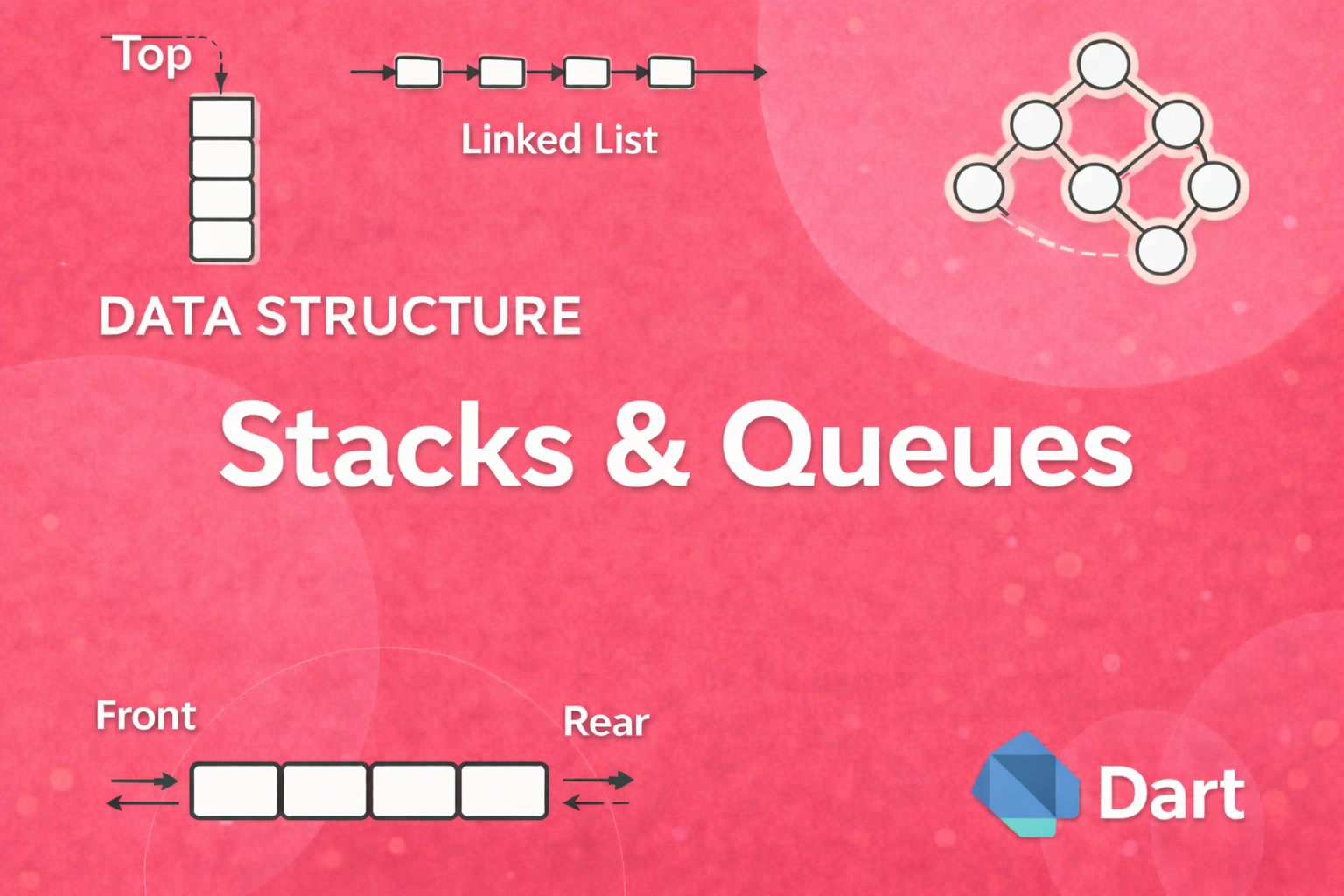
After arrays and linked lists, Stacks and Queues are the first data structures that introduce restricted access:
- You cannot access elements randomly.
- You must follow strict rules.
These rules make them extremely powerful for:
- Undo / Redo
- Function calls & recursion
- Task scheduling
- Breadth-first & depth-first traversal
- UI navigation in apps
2. Stack – Last In, First Out (LIFO)
Concept
A Stack works exactly like a stack of plates:
- Add plate → top
- Remove plate → top
Operations:
push()→ add elementpop()→ remove top elementpeek()→ view top elementisEmpty()
Top
[ 30 ]
[ 20 ]
[ 10 ]
Bottom
3. Stack Implementation in Dart
Stack using List (Array-based)
Dart’s List is perfect for stack behavior.
class Stack<T> {
  final List<T> _items = [];

  void push(T value) {
    _items.add(value);
  }

  T pop() {
    if (_items.isEmpty) {
      throw Exception("Stack is empty");
    }
    return _items.removeLast();
  }

  T peek() {
    if (_items.isEmpty) {
      throw Exception("Stack is empty");
    }
    return _items.last;
  }

  bool get isEmpty => _items.isEmpty;
}
Usage
void main() {
  var stack = Stack<int>();

  stack.push(10);
  stack.push(20);
  stack.push(30);

  print(stack.pop());  // 30
  print(stack.peek()); // 20
}
4. Real-World Stack Use Cases
1. Undo / Redo (Flutter Example)
Every text editor uses stacks:
- Undo stack → previous states
- Redo stack → undone states
class UndoRedoManager {
  final Stack<String> undoStack = Stack();
  final Stack<String> redoStack = Stack();

  void execute(String state) {
    undoStack.push(state);
    redoStack._items.clear();
  }

  String undo() {
    String state = undoStack.pop();
    redoStack.push(state);
    return state;
  }
}
2. Function Calls (Call Stack)
Each function call:
- Stores local variables
- Stores return address
- Pops after return
This is why deep recursion can cause stack overflow.
5. Classic Stack Problems
Balanced Parentheses
bool isBalanced(String input) {
  final stack = Stack<String>();

  for (var char in input.split('')) {
    if (char == '(') {
      stack.push(char);
    } else if (char == ')') {
      if (stack.isEmpty) return false;
      stack.pop();
    }
  }
  return stack.isEmpty;
}

void main() {
  print(isBalanced("(())")); // true
  print(isBalanced("(()"));  // false
}
Reverse a String Using Stack
String reverse(String input) {
  final stack = Stack<String>();
  for (var char in input.split('')) {
    stack.push(char);
  }

  String result = '';
  while (!stack.isEmpty) {
    result += stack.pop();
  }
  return result;
}
6. Queue – First In, First Out (FIFO)
Concept
A Queue works like a line at Starbucks:
- First person arrives → first served
Operations:
enqueue()→ add element to reardequeue()→ remove element from frontpeek()
Front → [ A ][ B ][ C ] ← Rear
7. Queue Implementation in Dart
Simple Queue using List
class Queue<T> {
  final List<T> _items = [];

  void enqueue(T value) {
    _items.add(value);
  }

  T dequeue() {
    if (_items.isEmpty) {
      throw Exception("Queue is empty");
    }
    return _items.removeAt(0);
  }

  T peek() {
    if (_items.isEmpty) {
      throw Exception("Queue is empty");
    }
    return _items.first;
  }

  bool get isEmpty => _items.isEmpty;
}
removeAt(0) is O(n) → not ideal for large queues.
8. Optimized Queue (Circular Queue Concept)
import 'dart:collection';

void main() {
  Queue<int> queue = Queue();

  queue.addLast(10);
  queue.addLast(20);
  queue.addLast(30);

  print(queue.removeFirst()); // 10
}
dart:collection.Queue is optimized and recommended for production apps.
9. Real-World Queue Use Cases
1. Task Scheduling
- Print jobs
- Network requests
- Background workers
2. Flutter UI Event Queue
- User taps
- Scroll events
- Gesture processing
10. Queue in Graph Algorithms (Preview)
Queues are essential for Breadth-First Search (BFS):
- Used in shortest path
- Used in level-order traversal of trees
void bfs(List<List<int>> graph, int start) {
  final visited = List<bool>.filled(graph.length, false);
  final queue = Queue<int>();

  queue.add(start);
  visited[start] = true;

  while (queue.isNotEmpty) {
    int node = queue.removeFirst();
    print(node);

    for (var neighbor in graph[node]) {
      if (!visited[neighbor]) {
        visited[neighbor] = true;
        queue.add(neighbor);
      }
    }
  }
}
11. Stack vs Queue Comparison
| Feature | Stack | Queue |
|---|---|---|
| Order | LIFO | FIFO |
| Insert | push | enqueue |
| Remove | pop | dequeue |
| Use Cases | Undo, recursion | Scheduling, BFS |
| Access | Top only | Front only |
12. Summary
- Stack → LIFO → undo/redo, recursion, parsing
- Queue → FIFO → scheduling, buffering, BFS
- Dart
Listcan implement both - Prefer
dart:collection.Queuefor performance - Both are foundational for advanced algorithms