1. What Is Intro Sort?
Intro Sort (short for Introspective Sort) is a hybrid sorting algorithm that combines the best of three worlds:
- QuickSort (fast average-case performance),
- HeapSort (guaranteed O(n log n) worst-case performance),
- and Insertion Sort (optimized for small subarrays).
It begins with QuickSort but monitors the recursion depth. If things get too deep (indicating worst-case behavior), it switches to HeapSort. For tiny partitions, it uses Insertion Sort for speed.
It’s the go-to sort in C++ Standard Library (std::sort) and many performance-critical systems.
2. How Intro Sort Works
High-Level Strategy:
- Begin with QuickSort.
- Track the depth of recursion. If it exceeds
2 * log₂(n), switch to HeapSort to avoid O(n²) behavior. - When sorting small partitions (e.g. size < 16), use Insertion Sort for cache-friendly performance.
Intro Sort intelligently adapts based on what it encounters — like a hybrid car switching between gas and electric.
3. Intro Sort Pseudocode
function introsort(array):
    depthLimit = 2 * log2(len(array))
    introsortHelper(array, 0, len(array) - 1, depthLimit)

function introsortHelper(array, start, end, depthLimit):
    size = end - start + 1
    if size < threshold:
        insertionSort(array, start, end)
    elif depthLimit == 0:
        heapSort(array, start, end)
    else:
        pivot = partition(array, start, end)
        introsortHelper(array, start, pivot - 1, depthLimit - 1)
        introsortHelper(array, pivot + 1, end, depthLimit - 1)
4. Step-by-Step Example
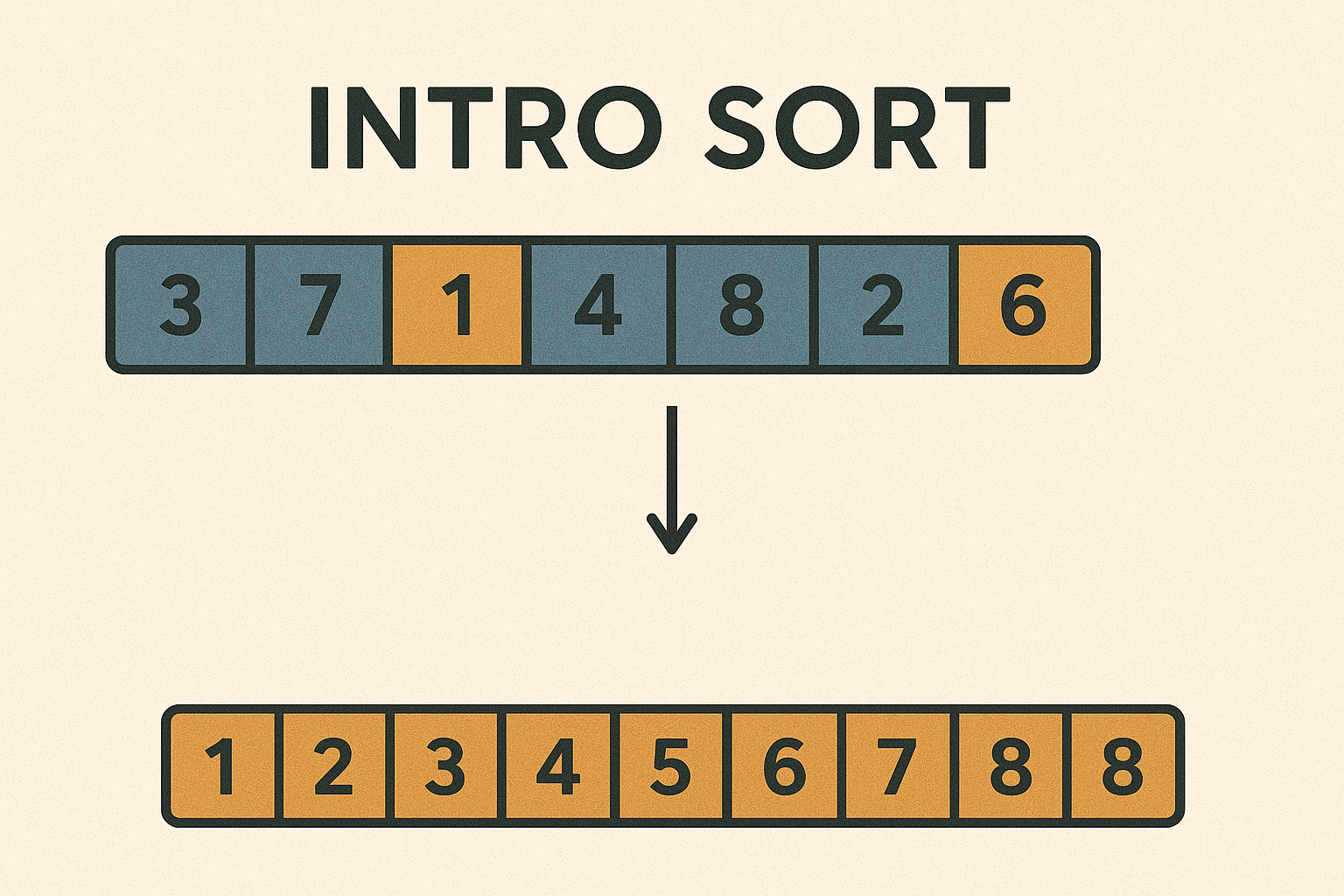
Let’s sort: [9, 4, 7, 3, 6, 2, 5, 8, 1]
- QuickSort is used first.
- If one partition starts to go deep (unbalanced), Intro Sort detects this.
- At a certain depth (e.g., 2×log₂(9) = 6), if we exceed it, switch to HeapSort.
- When partition size < 16, use Insertion Sort.
This allows fast sorting with safe fallback guarantees.
5. Time and Space Complexity
| Case | Time Complexity |
|---|---|
| Best | O(n log n) |
| Average | O(n log n) |
| Worst | O(n log n) |
- Space Complexity: O(log n) (recursive call stack)
- Stable Sort: No (unless extra work is done)
6. Intro Sort in Dart (Flutter-Friendly)
import 'dart:math';

Future<void> introSort(
  List<int> array,
  Function(List<int>) onUpdate,
) async {
  int depthLimit = (2 * (log(array.length) / ln2)).floor();
  await _introSortHelper(array, 0, array.length - 1, depthLimit, onUpdate);
}

Future<void> _introSortHelper(
  List<int> arr,
  int low,
  int high,
  int depthLimit,
  Function(List<int>) onUpdate,
) async {
  int size = high - low + 1;

  if (size <= 16) {
    await _insertionSort(arr, low, high, onUpdate);
  } else if (depthLimit == 0) {
    await _heapSort(arr, low, high, onUpdate);
  } else {
    int pivot = await _partition(arr, low, high, onUpdate);
    await _introSortHelper(arr, low, pivot - 1, depthLimit - 1, onUpdate);
    await _introSortHelper(arr, pivot + 1, high, depthLimit - 1, onUpdate);
  }
}

// Include _insertionSort, _heapSort, and _partition as helper methods
You’ll also implement heapSort, partition (Lomuto or Hoare), and insertionSort with visual onUpdate calls for animation.
7. Visualization with Flutter + CustomPaint
With IntroSort, you can showcase algorithm switching:
- Highlight when QuickSort is active (e.g., red bars).
- Switch to HeapSort (e.g., blue bars) when recursion limit hits.
- Use Insertion Sort (green) for small subarrays.
- Show stack depth and pivot points dynamically.
It’s one of the most impressive visualizations because of its adaptive nature.
8. When Should You Use Intro Sort?
Use Intro Sort when:
- You need predictable performance.
- You want QuickSort-level speed without O(n²) risk.
- You’re building a standard library or system-level sorter.
It’s battle-tested and production-ready.
9. Summary
Intro Sort adapts to the situation — starting fast, falling back when needed, and polishing with insertion for tiny jobs. It balances elegance with pragmatism and is trusted by real-world systems.
It’s not just a sort — it’s a strategy.
Coming up next: Block Sort — an advanced, stable, cache-aware algorithm used in high-performance libraries like Timsort.